Case study: Powering Wren Kitchens’ growing eHGV fleet
The Client
Wren Kitchens and Bedrooms operates an extensive logistics network supporting its manufacturing and retail operations across the UK.
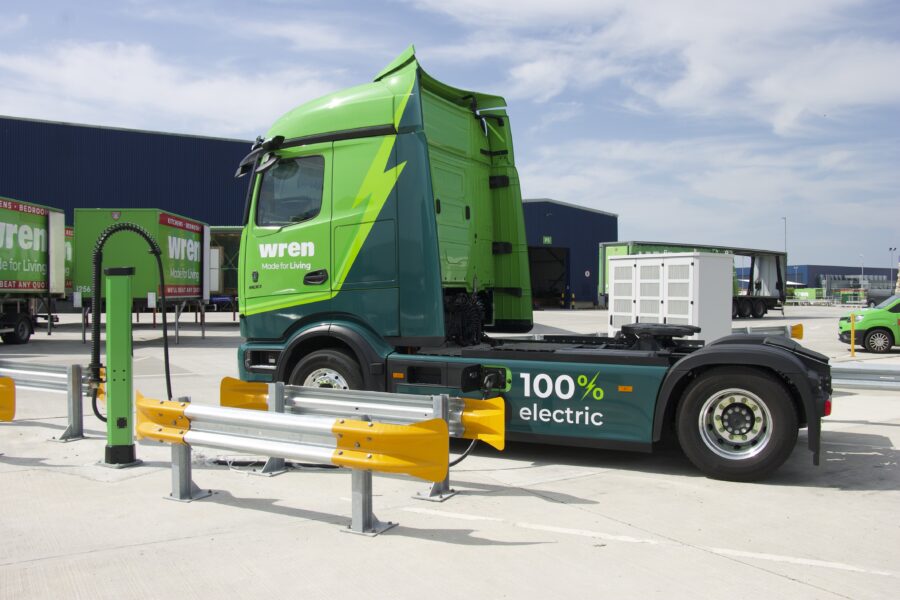
As part of its programme of initiatives to achieve Net Zero by 2030, Wren introduced Mercedes-Benz eActros 600 electric HGVs to its fleet, operating on regional inbound logistics routes from its Barton upon Humber site.
The Brief
Wren Kitchens needed charging infrastructure to support its new electric HGVs while fitting around the day-to-day demands of a busy working transport yard.
Mer supported Wren through its application to the Government’s Depot Charging Scheme, helping to develop the technical scope for the infrastructure required.
With funding secured, the brief was to design a charging solution around how vehicles moved through the Barton upon Humber site, while minimising disruption to its strict one-way system and busy loading and unloading areas. The infrastructure also needed to give Wren the flexibility to expand as its electric HGV fleet grew.
“The arrival of our first Mercedes-Benz eActros 600 trucks is a landmark moment in our sustainability journey. These are among the most advanced and safest heavy goods vehicles on the road today and by deploying them on our raw material routes we are removing fossil fuels from the very heart of our supply chain.” – Lee Holmes, Transport and Logistics Director, Wren Kitchens
The Solution
A detailed survey of the Barton upon Humber depot looked at how vehicles moved around the site, where they parked and how charging could be most effectively incorporated.
The final location chosen for the six charging bays was deliberately positioned away from the main operational areas, allowing trucks to return in the late afternoon, connect and remain parked overnight ready for shifts beginning from 4am.
The bays were widened for improved access, with six Kempower satellite chargers positioned immediately alongside the trucks’ charging ports. This allows vehicles to charge with or without their trailers attached, giving Wren the flexibility to charge before or after loading and enabling drivers to top up mid-shift without uncoupling. This offered an improved driver experience and ease of use.
“The starting point for us was understanding how Wren’s operation worked day to day. This is a busy transport yard, so we didn’t want the charging infrastructure to dictate how the fleet operated; we needed to design it around the fleet. That meant choosing a location that was further from the building and required almost 2km of cabling. Alternative positions closer to the building would have made installation easier, but offered less space and limited future expansion.” – Dan Robinson, Strategic Sales Manager, Mer Fleet Services
Making the available power work harder
The six satellite chargers are supplied by a triple Kempower Power Unit, which dynamically distributes available power between connected vehicles.
The first two bays are configured to provide up to 200kW each, giving the earliest returning trucks a head start before more vehicles arrive and dynamic power distribution begins across the remaining bays.
The infrastructure was originally planned around six electric HGVs. Wren has since increased its fleet to ten and is successfully charging all ten using the existing infrastructure, with the flexibility to introduce vehicle rotation as the fleet grows further.
The result is a charging solution designed around the practical realities of Wren’s operation today, with the space and flexibility to support its continued transition to electric HGVs.
“Partnering with Mer was a natural fit given their expertise, and they’ve played a key role in helping us deliver the infrastructure needed to support the arrival of our new eHGVs.” – Lee Holmes, Transport and Logistics Director, Wren Kitchens