EV Fleet Charger Installation On Your Business Premises – What’s Involved?

This guide walks you through what to expect when planning your charging setup to transition to an EV fleet. We cover everything from understanding costs to making smart decisions that future-proof your business.
- Book a site survey for expert guidance on layout, hardware, and feasibility
- Assess your power capacity to avoid costly upgrades
- Match charger speed to usage – fastest isn’t always best
- Plan for real-world demand from employees, fleets, or customers
- Consider installation variables, such as permissions, cable runs and groundwork
Book an EV Charger Site Survey
In 2023, a survey in the US by CBR[1] found that 30% of companies favour offices or premises with EV chargers, and that rises to 40% at large companies. As more employees return to the office, EV charger installation at business sites, can be an attractive benefit for fleets and employees alike.
Likewise, if you operate (or plan to) a fleet of commercial EVs, on-site charging makes practical and financial sense. In fact, according to Imperial College London[2], the Workplace Charging Scheme (WCS) had already contributed to the installation of over 50,000 business EV chargers by January 2024.
Assuming that you have a fair idea of what you are looking for and what you need, you should contact a reputable charge point operator (CPO), to request a site visit before taking any further action.
The operator will be able to:
- Give guidance on the right hardware and charger speeds for your EV fleet
- Identify ideal locations for your EV fleet charging infrastructure, factoring in charging logistics and other business considerations
- Find out if any capacity upgrades or ground work are required
- Discuss requirements for load balancing
- Give you a quote for commercial EV charger units and installation
- Help you understand which EV fleet infrastructure ownership model is right for your business
Understand Your Site’s Electrical Capacity
An operator will need to assess your site’s maximum electrical capacity and the space capacity (the difference between the actual load used and the maximum available) to give you an accurate fleet EV charger installation quote.
In some cases, your site may need a load balancer to support additional electrical load, especially if you need to charge multiple fleet EVs at the same time, or use rapid or ultra rapid chargers.
Choosing Your Fleet EV Charger Unit Speed
The number and type of EVs using your charging infrastructure will impact your choice of commercial EV charger, and how many you need. It depends on several factors, including how many fleet EVs you plan to operate, their combined battery capacities and charging times, your proposed charging schedule, and whether you plan to expand your fleet in the future.
Depending on power levels, your business will be able to install fast chargers 7.4kW up to 22kW or rapid/ultra rapid chargers up to 350kW. Fast and rapid chargers will mean a quicker charge time, but they will also increase the peak electrical load.
Remember that the number of vehicles being charged is closely linked to downtime. So specific business needs and operations may mean you regularly have a large number of EVs charging for a long time all at once.
So, if your business operates mainly during daylight hours and you plan to charge your fleet overnight, you will need more charge points, but they won’t necessarily need to be rapid/ultra rapid chargers. At the other end of the scale, if you’re operating around the clock, with vehicles coming and going, a mix of fast and rapid/ultra rapid chargers may be a better option.
EV charging management software, such as load balancing technology, can mitigate this to some extent but there is ultimately no substitute for overall grid connection capacity.
The Benefits of EV Fleet Charging
One of the main benefits of planning your EV fleet charging strategy is that you have considerable control over when the chargers are used and the types of EV being charged. As a result, you can design your infrastructure to fit your organisation’s unique needs.
On the other hand, public or commercial EV charging stations will have to estimate this, and may have to build in more contingency than necessary.
The operator visiting you will be able to advise on the best speed of charger(s) to accommodate most vehicle models. If your business needs allow, we tend to recommend starting off with a few chargers and assessing your fleet usage before expanding.
The Impact of Location on Fleet EV Charger Installation Costs
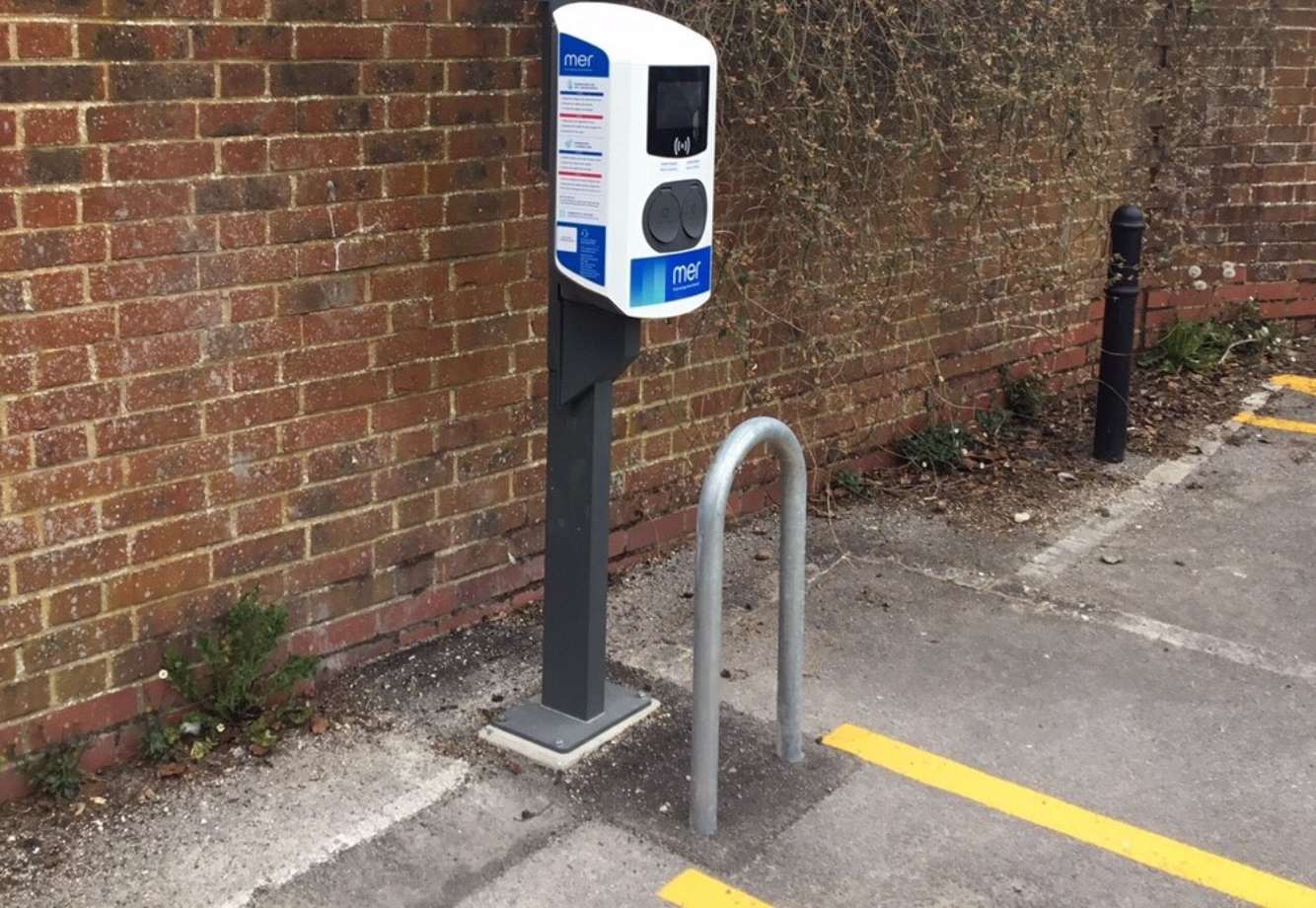
Your fleet EV charger installation costs will also be heavily influenced by the distance between the charging station and the meter cupboard in your business premises. So location is very important. Even the length of cable needed underground will impact the price.
Likewise, the ground surface and existing infrastructure will also play a part. If complex earthworks and building work are required, costs will be higher.
Selecting The Right Fleet EV Charging Hardware
To work out what type of charging hardware you need, you’ll need to know the answer to the following questions:
- Where will your EV chargers be installed to be utilised effectively? Slower, overnight charging simply requires parking space, but EVs using rapid charging may need clear access in and out of the area. For delivery fleets, will the EV need to be loaded/unloaded while being charged?
- Will you need the chargers to be pole mounted or wall mounted?
- Do you require tethered (with a cable) or untethered (without a cable) EV chargers?
Tethered vs Untethered Commercial EV Chargers
The advantage of choosing a tethered EV charger is that your vehicles won’t have to carry the charging cable with them, whereas having untethered cables allows for more flexibility for those EVs with a different connector.
Our fleet EV specialists will be able to give you further advice during your site visit, but the choice will depend entirely on how your fleet intends to operate.
Other Costs & Considerations
EV Charging Signage
If you want to mark out your charge stations, you may want to consider installing signage.
Council Permissions
In most cases, you won’t need planning permission for business EV charger installation, but you may if the installation is:
- Near a highway
- In a listed building over 1.6m in height (for ground-mounted units)
- More than 0.2 cubic meters in volume (for wall-mounted units).
Speak to your local council to ensure you have the right permissions.
Making The Right Choices During Installation
The majority of the costs connected to fleet EV charging infrastructure are related to the day-to-day operating expenses, not the capital outlay (although this can still be significant). Understanding the points below in the early stages of getting set up will help keep your ongoing costs low.
- High installation costs: It’s important to choose experience over initial savings when it comes to installation. Some businesses have found themselves having to fund multiple site visits due to the use of inexperienced electricians. We take care of you throughout the journey, from consultation to installation. We can guarantee a high level of customer service from experienced installers.
- Electricity connection costs: The costs of setting up a new electricity connection can be steep. Think carefully when it comes to installing your EV charge points. Are you able to select locations where a new charger can be installed and make use of an existing connection?
- Load balancing: If you opt for multiple EV charge points, it’s possible the network will be planned for maximum load, which you will rarely need. Load balancing will prevent overloading of the electrical connection and help to lower connection fees and peak tariffs.
Fleet EV Charging Points For Businesses
There are a lot of aspects to take into consideration when it comes to fleet EV charger installation . However, understanding more about the process and the impact of your choices, will help you make smarter decisions throughout and you’ll see the benefits long-term.
We’ll work closely with you and your organisation to ensure you get the best EV charging installation for your fleet’s current and future needs.
Future-proof your business with EV fleet charging
Want to find out more about our EV chargers for fleet vehicles, including hardware and installation costs? Our team of charging specialists can assist in guiding you through the full process.
