
Benefits of 3D Modelling to Plan Your EV Fleet Transition
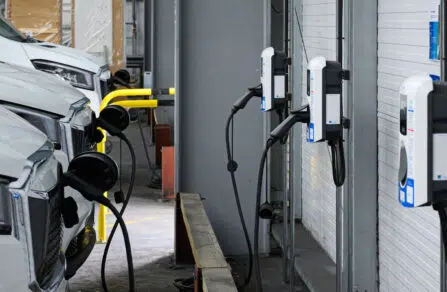
Mer’s advanced 3D modelling during the planning phase helps to av...

There is an important role for data when it comes to planning the next step in fleet electrification. Whether you’re transitioning from an ICE fleet or using fleet efficiency monitoring to make further improvements to your EVs, it provides hard evidence and prevents important decisions from being made on gut-instinct. In this blog, we discuss grid connection capacity, how to calculate the energy demand of your charging infrastructure and the most important data to track for your EV fleet.
Despite having an analytical approach to vehicle management, data can be a blind spot for many when it comes to planning the electrification of their fleet.
In our private and working lives, we are used to electricity being abundant, when in fact it is a finite resource under pressure from competing demands. With fossil fuels, ensuring the pumps work when we pull up to refill is somebody else’s problem.

But the workplace or depot is part of a local network drawing energy from the same source. A site drawing down more than its fair share can cause the lights to go off in neighbouring buildings.
You could think of electricity filling a battery as being like water filling a bath. If you install 20 baths in your home and start to fill them all at once, your neighbour will get nothing when they turn on the tap. To prevent this from happening, an energy provider will set a limit on how much power a workplace can use and apply surcharges if the agreed limit is breached.
It is also quite possible that a grid connection is not sufficiently high capacity to provide the energy needed to charge multiple EVs in a fleet all at once.
To revisit the bath analogy, you could fill all 20 at the same time, but much slower than if you were just filling one. If you want to fill them faster, you need a bigger water pipe. Similarly, if your electricity connection is not high enough to charge your EV fleet and power all the other operations in your business, something is going to give when you plug in.
Three key metrics help paint the full picture of where to start on your EV infrastructure journey, ensuring you meet your fleet efficiency goals.
The capacity of your grid connection.
Peak power demand from your premises and spare capacity.
Whether the spare capacity meets your EV charging needs.
Before even getting to determining whether your existing power supply can meet your EV fleet’s needs, you must determine how much power you’re using, or intend to use.
This is where data and analytics comes in. Using your existing fleet data, you can work out the total mileage driven in a given period (usually per day). You then take this and factor in your chosen EV’s battery capacities and ranges.
By understanding how many miles you need to cover, and the maximum amount a given vehicle can handle, you’ll be able to work out how many EVs you’ll need to keep your operations running.
Finally, you add up the total energy (and therefore charging) requirements for the day.
You also need to factor in your other business operations to calculate peak power demand. Everything from the kettle in the kitchen to lights in the office and heavy machinery needs to be included.
The best way to do this is to check your energy bills or use data from your building or energy management system. We would advise using 12 months of data as an absolute minimum here. Equipped with this data, and adding your EV charging requirements, it should be a simple process to work out whether you have capacity for the chargers your EVs will need.
Alternatively, Mer can undertake load testing at your premises to get an accurate figure. We can fit a load tester that will provide a week’s worth of power demand readings. Then, our design engineers will analyse the results to understand peak and total power demands, recommended charging infrastructure, and povide guidance on estimated battery charging times, future-proofing and overload prevention.
Now you know your requirements, you need to determine the existing power capacity of your site and whether it can handle what you need it to. This information will be readily available from your distribution network operator (DNO).
From here you could find yourself in one of three potential scenarios
Even if your site can meet your demands, it’s essential not to rush into any investment. There are still plenty of things that need to be considered and can go wrong. For example, do you have the physical space to be able to charge all your EVs as you need to? Can you still carry out your operations while the fleet is charging?
Do your operations best suit installing more chargers, but with a lower output, so you can charge your fleet overnight? Or do you need rapid or ultra rapid chargers that are used during the day, but have a much faster turnaround?
Informed, evidence-based decisions about EV charging and achieving maximum fleet efficiency are only possible with the right data, and working with an expert provider like Mer.
Mer’s advanced 3D modelling during the planning phase helps to av...
The UK’s local electricity grids are struggling to cope with mode...

Fleet managers must consider energy management for their EV trans...
