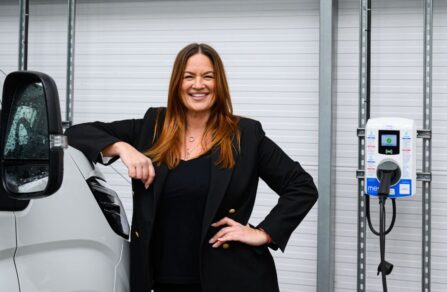
Natasha Fry on Women, Leadership, and the Future of Fleet Electrification
Natasha Fry, Chief Commercial Officer at Mer Fleet Services, has ...
*Updated September 2025
Over the last 10-15 years, the UK’s electric vehicle (EV) market has grown rapidly, and with the proposed ban on the sales of new ICE vehicles in 2030, it will only increase further. As of July 2025, there were over 1.6 million fully electric cars on UK roads, compared to just 396,945 at the end of 2021 – making up about 4.75% of the total.
In 2025 to date, 21.5% of all new cars registered were full EVs, up by nearly 60,000 for the same point in 2024. If we include all plug-in cars, such as Plug-in Hybrid Electric Vehicles (PHEVs), there are just under 2.5 million on UK roads.
Of the new cars sold in July 2025, 33.8% were either PHEVs or full EVs.
As costs continue to rise, consumer behaviours are changing accordingly, particularly when it comes to spending at retail environments. Although up significantly from the lows of mid-2022, retail spending has largely flatlined since the beginning of 2024. Likewise, inflation hit an 18-month high in August 2025 as consumers felt the pinch. With further energy price rises predicted for the end of 2025, retailers need to do what they can to maximise their revenue.
One way of doing this is by bringing EV charging to their sites, as commercial site owners have access to a unique avenue for revenue potential. Alongside increasing revenue, this can also revitalise consumer attention and loyalty amidst a decline in retail spend as the cost-of-living crisis continues.
When EV drivers park and charge their vehicles at retail environments, site owners will receive a direct income through bay renting and the sale of electricity, depending on the financial model they choose with their charge point operator.
Alex Hinchcliffe, Director of Public Charging at Mer UK, outlines the financial opportunities with EV charging and highlights examples of how much landowners can expect to earn through their charge points:
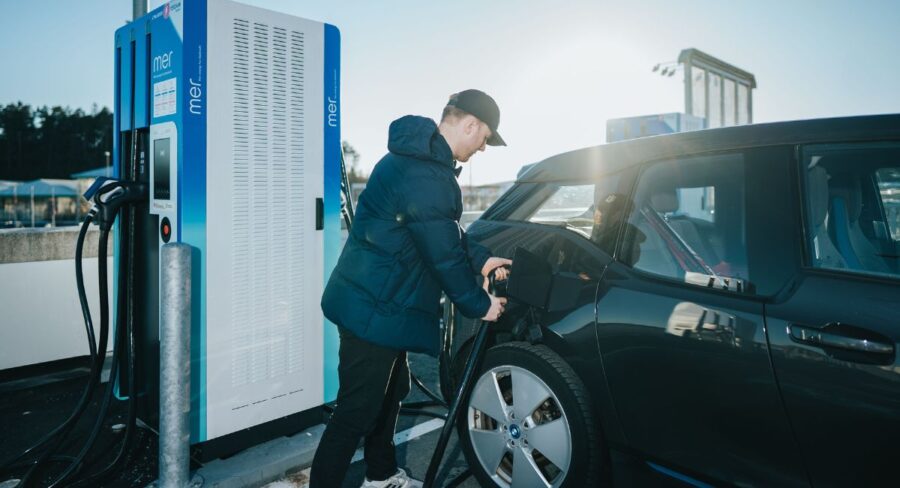
Refuelling an ICE vehicle takes a matter of minutes. On the other hand, EVs take longer to top-up – anywhere between 20-60 minutes depending on the car and the charger type.
Landowners can take advantage of the prolonged time EV drivers will spend at their site while their vehicle charges. By installing EV charging at a commercial site, owners will increase the dwell time of their visitors. This will lead to further opportunities to boost revenue, as this increased time can encourage increased expenditure from drivers.
With the opportunity for drivers to explore the shops, go to the gym, grab a coffee and a snack, or do their weekly food shop whilst their vehicle is charging, charging at a retail environment becomes more attractive for drivers.
In a busy world, people want convenience, and allowing them to do multiple things at once is much more attractive to many customers. For example, if an EV motorist has a choice between Retail Option A and Retail Option B, they may be more likely to choose the one that allows them to charge at the same time.
Your charging infrastructure will also influence the future stability of and opportunities for your site. Having had a positive experience charging at your site, your commercial EV charging points will encourage drivers to return the next time they need to top up on the go, therefore boosting consumer loyalty and attracting people back to your site.
Landowners may question the need for EV charging when low emission vehicles have not yet completely displaced internal combustion engine (ICE) vehicles.
As we’ve seen above, EVs and PHEVs now make up around 33% of the cars on UK roads, and this is only going to increase further as ICE vehicles are phased out and fuel costs continue to rise. Getting ahead of the competition may allow site owners to capitalise on the early demand, as well as build familiarity and routine into motorists’ lives.
As more and more drivers make the switch to electric mobility, demand for the use of commercial EV charging points will indefinitely rise. Mer witnessed this increasing demand at Stane Retail Park, a 15-acre retail park in Colchester, Essex, which is home to outlets including B&Q, Aldi, M&S and Mountain Warehouse. The initial development saw the installation of three 75kW rapid chargers and two 22kW fast chargers at the site. Before long, cues started to appear for the chargers, as more and more EV drivers looked to charge their vehicles there.
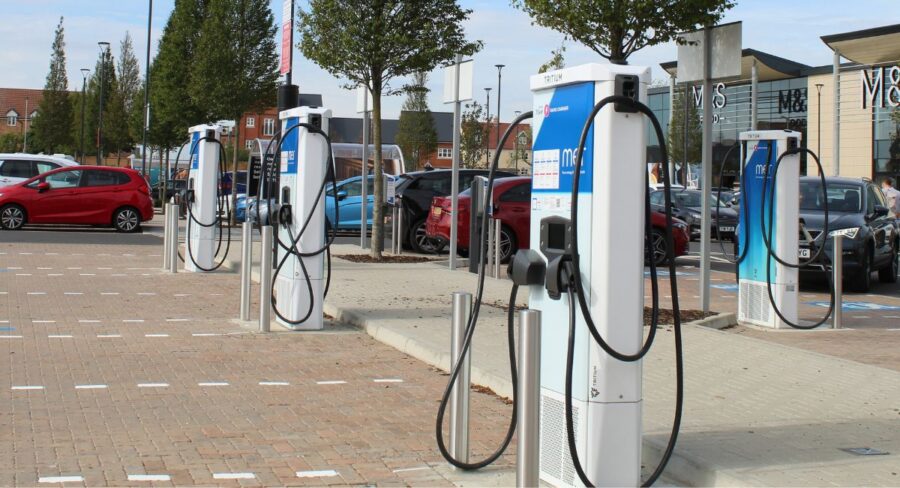
Stane Retail Park
This demand prompted a second phase in the EV charging development with The Churchmanor Estates Company Plc, the park’s owners. An additional four 75kW rapid chargers were installed at the site, which takes the total number of charging bays to 18.
The need to accelerate the EV charging offering at Stane Retail Park in line with demand not only evidences the growing need for EV charging, but it also affirms the strong potential EV charging has for revenue generation in the long term.
Beyond the intrinsic financial benefits of EV charging, commercial landowners must consider the need to install chargers from a regulatory perspective.
UK building regulations now require every new commercial and residential building with an associated parking space to install one EV charging point. New commercial buildings undergoing a major renovation with 10+ parking spaces are also required to have one charge point for every five spaces. What is more, 2025 will bring additional regulations in, as existing commercial buildings with more than 20 parking spaces will require a minimum of one charge point.
EV charging also enables landowners to meet the expectations of current and prospective retailers. As EVs affirm their place in the UK’s transportation sector, tenants of a commercial environment are likely to prefer to occupy sites which offer EV charging than sites that do not.
We’ve produced an in-depth Guide to Installing Commercial EV Charging Hubs, which contains everything you need to know to update your premises and meet changing consumer preferences.
Natasha Fry, Chief Commercial Officer at Mer Fleet Services, has ...
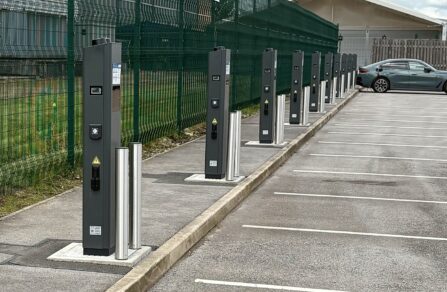
Mer Fleet Services delivered a full end-to-end EV charging soluti...
Mer Fleet Services, the specialist fleet electrification business...
Sources#