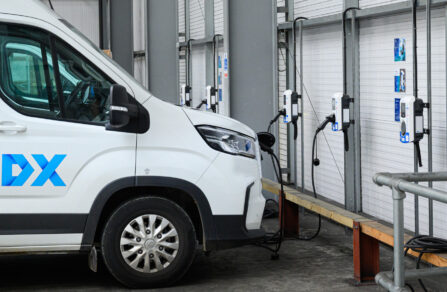
Powering DX Delivery With Last Mile EV Charging
DX delivery chose Mer as its charging partner to support its last...
Cutting carbon from the last mile is increasingly important to businesses and consumers, for both environmental and financial reasons. In this article, we explore how being at the forefront of the EV logistics transition can help last-mile delivery operators get ahead of the competition by:
Last-mile logistics operators are used to a challenge. This is a highly competitive sector with tight margins and one where customers increasingly demand faster and more transparent fulfilment. There are also three further demands on last-mile delivery companies, all centred around sustainability:
Consumers want their online shopping delivered in more sustainable ways, and this is the finding repeated in customer surveys from the past few years. The ‘conscious consumer’ is aware of how their habits and actions impact the planet and their local communities, and they adapt their behaviours accordingly. Essentially, if you want to keep their custom, you will need to offer greener deliveries.
Larger companies, as well as those listed on a public exchange, are required to report their carbon footprints via SECR (Streamlined Energy and Carbon Reporting) legislation. For many, this means working with their suppliers and logistics partners to drive down their emissions.
For last-mile delivery providers, this offers a huge opportunity to win new business (or retain existing clients) for those who proactively adopt EVs and effectively communicate this change to their B2B client base.
Legislation and regulations continue to tighten in terms of vehicle access to city centres. As UK cities like London, Edinburgh, Birmingham, Bristol, Oxford, Glasgow, and others all implement Low Emission Zones (LEZs) or even Zero Emission Zones (ZEZs), last-mile delivery companies will need to transition their fleets to meet tighter regulations.

Image Source: Getty Images
In many cases, commercial vehicles are subject to even tighter restrictions, and significant savings can be made by adopting compliant vehicles.
Last-mile logistics has the potential to play a key role in the green cities of the future. Helping to cut congestion and emissions without impacting the volume of deliveries will be vital. In fact, if operators do not embrace this opportunity, they risk being left behind by their competitors. Switching to EVs can improve your business resilience and help future-proof your company.
In addition, if you look at the total ownership costs of electric vehicles (EVs), the battery-powered vans are looking like a smart investment for last mile logistics operators. And the business case gets even better if EVs can help you avoid charges from clean air zones.
Whether you are electrifying your first vehicles or planning the next stage in your EV fleet roll-out, it is vital to understand the infrastructure requirements. A failure to effectively plan your charging needs could end up delaying deployment, as you will not be able to efficiently keep the vehicles powered and ready to go, leading to operational failures and unhappy customers. Similarly, having to resort to using public charging infrastructure, even in extreme circumstances, could cost more in the long run.

Be wary of a charging provider who simply asks what chargers you want and sells them to you. Many more complexities need to be properly considered. We take a methodical and consultative approach, with questions including:
From your perspective, questions to ask potential charge point providers include:

Ultimately, picking a charging partner with a track record of working within your sector is much more likely to save you money and hassle in the long run. You can read more here about how we helped electrify IKEA’s last-mile fleet.
Transitioning to an electric last-mile delivery fleet can improve business resilience, help with customer retention, and save you money. However, it does require a clear strategy and the right partners to help you execute it.
Last-mile logistics operators are experts at implementing new technology to enhance their operations, but can still feel daunted by the multiple facets of the EV transition. If you’re wondering where to start or what next steps to take, Mer has the answers.
DX delivery chose Mer as its charging partner to support its last...

Last mile logistics operators need to think first about charging ...
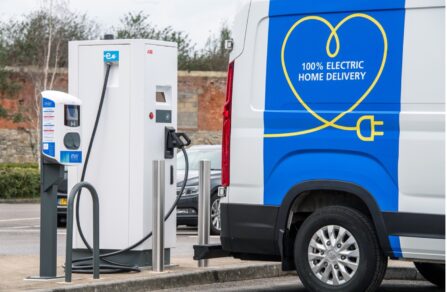
IKEA has today announced a £4.5million investment in a nationwide...