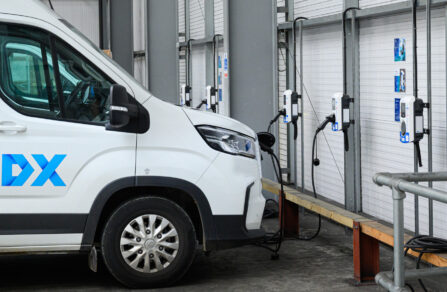
Powering DX Delivery With Last Mile EV Charging
DX delivery chose Mer as its charging partner to support its last...

Last mile logistics requires fleets to be agile and responsive to change. Although many of the challenges of switching to EVs are entirely avoidable, the benefits are clear, and effective route planning can mitigate many fleet managers’ apprehensions, we still encounter some (unfounded) hesitancy.
In this article, we explain how EV fleet route planning can help logistics managers:
Electric vans and trucks are ideal for last mile delivery fleets, as they are typically operating on urban routes with predictable mileage and excel on roads with low traffic speeds. However, as more and more governments, cities and local authorities around Europe introduce or expand low-emission zones (LEZs), fleet operators can be liable for significant additional operating costs when running internal combustion engine (ICE) vehicles.
Nevertheless, despite the myriad of environmental, financial and reputational benefits of commercial fleet electrification, some operators remain wary of introducing electric vans and trucks into their last mile fleets in case they have a negative operational impact.
Last mile delivery is a highly competitive sector where margins are tight. Customers are unforgiving and have plenty of other providers to choose from, so if EVs do not perform, it can lead to losing contracts.
However, is playing it safe really just asking for more trouble in the future? The sale of new ICE vehicles is due to be banned across the EU by 2035 (1), with countries like the UK aiming for 2030 (2), which may force fleet operators into a costly and rushed transition.
Also, consumer opinions are often ahead of legislation. A 2024 study by BusinessDasher (3) found that:
Embracing fleet electrification with a sustainable, planned and sound transition strategy will allow businesses to reap the benefits of EVs.
Making your electric last mile fleet work efficiently by using proper route planning can make the transition from petrol/diesel vehicles much easier and cost-effective.
Firstly, it will make your electric fleet even more environmentally friendly. Take the time to think through and plan a delivery route that makes logical sense, by looking holistically at your vehicle’s entire operation and the stops it needs to make in a shift.
You should know the maximum range of your commercial EV, and you can ensure your chosen route maximises this. For example, with careful planning, you can avoid having to cover the same roads more than you have to, you can identify the shortest route between points, and you can ensure that it goes via EV charging points, should the vehicle need to recharge in the field.
This should reduce the mileage the vehicle covers in a shift, maximising effective range and reducing charging costs. Reducing mileage means less energy consumed by each EV, which in turn means lower costs. It also reduces wear and tear on vehicles and makes your last mile logistics even more efficient, meaning EV route planning and optimisation is better for the bottom line.

Currently, EVs are more expensive to buy or lease than diesel vans and trucks. However, EV delivery route optimisation can help you mitigate this extra cost by finding savings elsewhere, with no risk to your operational output.
Route planning platforms and apps can help ensure that any fleet electrification project is a smooth transition for last mile logistics operators. By taking data from your existing operations and running it through an optimisation algorithm, you can easily identify which routes and vehicles are already suitable for EVs.
Typically, this is a simple matter of ensuring that the EV has sufficient range and payload to complete a full shift and can slot into your existing operations without you needing to make major changes. If your EV doesn’t, it can plan a route that takes charging stations into account.
However, a good EV delivery route optimisation platform will go a step further. By crunching all the numbers, it can tell you how to change your routes, schedules and vehicle loads to accommodate more EVs.
By utilising this data you, can build a charging schedule that uses the best times to charge your vehicles. Often, one of the best opportunities to charge with minimal impact is between shift changes, since there is already vehicle downtime.
There is a famous military saying that no plan survives first contact with the enemy – and the same is true when it comes to planning last mile deliveries. An EV delivery route planner can devise the best routes and delivery schedules to minimise mileage and empty running; but it cannot predict emergency road closures, heavy congestion, or last-minute changes from customers.
Luckily, software developers have already considered this and have built additional functionality into their EV route planning products. A good route optimisation platform can recalculate routes in real time, helping to ensure that you can still meet client delivery windows and avoid late delivery penalties or reputational damage.
When your business model is based around delivering the goods on time, efficiency is paramount. Organisations can save money through load balancing and utilising vehicle downtime for charging. Fleet scheduling software can help here, as if a vehicle needs an extra hour on the charger before it leaves the depot, the optimiser can plan that in. And if a vehicle needs to be loaded or unloaded, it can be charged during that period.
Range anxiety is largely a thing of the past, and the averange range for an EV van is 164 miles, way more than the average distance travelled by 50% of the UK’s van drivers. However, if a vehicle must go beyond its range capabilities while out in the field, EV route planning means you can find a suitable rapid or ultra rapid EV charging location and plan a top-up charge into its schedule.
Adding electric vehicles to your last mile fleet can bring significant benefits but it requires careful planning and working with expert partners. If you’d like to find out more about how to electrify your last mile logistics operations, Mer is here to help.
We’ve worked with a range of public and private sector organisations to deliver successful EV charging infrastructure projects, and we’re always eager to bring our expertise to exciting new relationships.
Sources
DX delivery chose Mer as its charging partner to support its last...
IKEA has today announced a £4.5million investment in a nationwide...

Last-mile delivery operators must continue to electrify their fle...