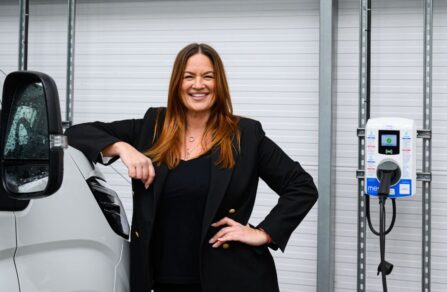
Natasha Fry on Women, Leadership, and the Future of Fleet Electrification
Natasha Fry, Chief Commercial Officer at Mer Fleet Services, has ...

With Ultra-Low Emissions Zone (ULEZ), and other UK areas proposing Clean Air Zone charges, as well as financial and societal pressures, it’s a question of ‘when’ and not ‘if’ your business should make the switch to an electric vehicle fleet (EVs).
The UK government offers several electric car tax incentives in the form of cuts, grants and exemptions for businesses and employees. Whether you operate an EV fleet, or provide EV Benefits in Kind (BIK) for your employees, we’ve summarised the latest information you should be aware of below.
Regardless of possible exemptions, all private and commercial vehicle owners must go through the process of taxing their vehicles. But because Vehicle Excise Duty (VED) was calculated according to CO2 tailpipe emissions for all vehicles registered since March 2001, most EV owners used to be exempt from any charge. Changes introduced in April 2020 also meant that new and existing electric cars with a list price of over £40,000 were exempt from the 5 year ‘Premium rate’ tax.
However, new rules in place since April 2025 now require EV drivers to pay VED. Also, there is a ‘luxury car tax’ fee that applies to EVs with a list price that exceeds £40,000. Unfortunately for owners, these changes have been backdated, which means that even if you didn’t pay VED before, you likely will have to now.

Most EV owners will have to pay VED at £195 for 12 months, and if it was registered after 1st April 2025 and cost more than £40,000, an additional luxury car tax (officially known as the Expensive Car Supplement) fee of £425 will apply. This will take the total to £620 per year. However, zero-emission vehicles registered on or after this date will only have to pay £10 VED for the first year.
If your EV was registered before April 2017, VED will cost £20 per year. For most businesses who replace fleet vehicles every few years, this is unlikely to be relevant.
Traditionally, employers have been able to offer company cars as an added benefit when attracting new employees. But uptake has been dwindling over the years thanks to rising BIK tax rates. That is, the tax an employee must pay for receiving this benefit, based on a vehicle’s fuel type, CO2 emissions and personal income tax percentage.
However, the government’s April 2020 tax update sparked change, with some generous tax incentives laid out for any business adding electric powered vehicles to their company fleet. The electric car tax for benefit-in-kind for pure-Evs increased to 1% in April 2021 – 2022 and then 2% from April 2022 – 2023. Lower emission vehicles (up to 50g/km, 130+ mile range) registered before 6 April 2020 had a frozen BIK rate of 2% until April 2023.
In 2025, these have changed, and the current BIK company EV rates are as below:
| Tax Year | Pure EVs | Lower emission (hybrid) vehicles (1-50g/km emissions) 130+ mile range | ICE Vehicles |
|---|---|---|---|
| 2025/26 | 3% | 3% | 37% |
| 2026/27 | 4% | 4% | 37% |
| 2027/28 | 5% | 5% | 38% |
| 2028/29 | 7% | 18% | 39% |
| 2029/30 | 9% | 19% | 39% |
Part of the UK government’s efforts to improve air quality has seen the introduction of ‘Clean Air Zones’. Some zones will mark out areas where initiatives are in place to reduce emissions, and others will see the introduction of new charges for vehicles that don’t meet minimum emission standards.

London launched its ULEZ in 2019, and then expanded it to all of Greater London in 2023. As of 2025, there are 14 cities with various forms of Clean Air Zones in the UK:
Daily charges can be steep, and particularly high for larger vehicles. For example, London’s ULEZ currently charges £100 a day for buses, lorries and coaches at Euro 5 or below.
However, ultra-low-emission vehicles with a significant zero-emission range are often exempt from all CAZ charges. For last mile delivery fleets who mostly operate in urban areas, switching to an EV could save the business money, even with rising VED costs.
In addition to 0% VED and BIK rate cuts, there are many grants and additional incentives available to businesses to help make the transition to electric possible. For example:
It’s also worth exploring the grants available via your local council authority’s website.
We are starting to see meaningful commitment from several large fleet owners, notably from delivery firms including IKEA, Royal Mail, DPD, UPS and Hermes switching to EV Fleets.
Royal Mail has introduced close to 300 green-wrapped electric vehicles onto their usual delivery routes since the start of their 2018 involvement with Optimise Prime, the world’s largest commercial electric vehicle project. These were supplemented with the roll-out of another 87. Their vans can be found in parts of London and across the South East.
UPS placed an order of 10,000 new electric vans, and had the vehicles in action across the UK, Europe and North America by 2024. At the same time, DPD requested 300 Nissan e-NV200s for roll out in the UK, taking their number of EVs on the road to 450. The firm has expressed a desire to have 10% of its fleet at each of its 68 UK depots powered by electricity.
Hermes transformed their Beckton depot to 100% electric. It now operates with 32 battery-electric Nissan eNV200 vans for central London deliveries.
Aside from logistics firms, many other fleet owners are showing commitment. For example, global specialists in energy management Schneider Electric plan to introduce ‘charging parks’ in their offices and factories and replace 14,000 vehicles in over 50 countries with electric cars by 2030.

At Mer, we supported IKEA to reach its aim of 100% zero-emission deliveries by 2025, by analysing and supporting the installation of 200 chargers at sites across the UK.
Need a purer way to power your fleet? We set you and your people up with the whole package, so it’s as easy as charge, start, set off.
Natasha Fry, Chief Commercial Officer at Mer Fleet Services, has ...
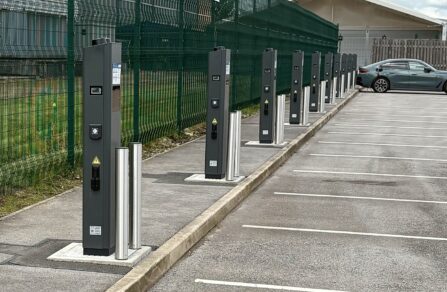
Mer Fleet Services delivered a full end-to-end EV charging soluti...
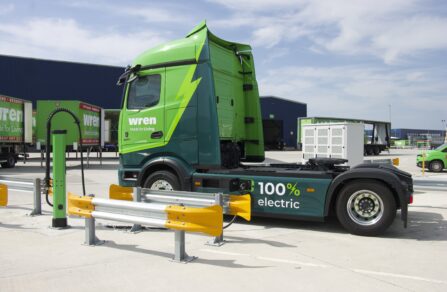
Mer Fleet Services, the specialist fleet electrification business...