
Fleet Electrification in 2026: Why Planning Determines Success
The EV transition can feel confusing for UK fleet operators. Ince...
| Country | Language |
|---|---|
 Deutschland
 |
de / en |
 Norge
Norge |
no / en |
 Sverige
 |
sv / en |
 United Kingdom
 |
en |
 Österreich
 |
de |
 mer.eco
|
| Country | Language |
|---|---|
|
Deutschland |
de / en |
|
Norge |
no / en |
|
Sverige |
sv / en |
|
United Kingdom |
en |
|
Österreich |
de |
|
mer.eco
|
Whether you are expanding your EV charging infrastructure or adding your first opertaional site EV charge point, it’s important to be compliant with the latest legislation, but what does it entail?
In this blog: Charge Point Security | Charge Point Ease of Use | What to Expect | What Do I Need to Do Next?
The UK Government introduced the first part of the Electric Vehicles (Smart Charge Points) Regulations 2021 in June 2022. But now we’re coming towards the end of 2025, has anything changed and are any updates or amendments planned for the future?
To clarify, the legislation only covered:
They do not cover charge points:
The smart charging regulations legislation was rolled out in two parts, with part two (confusingly labelled Schedule One) coming into effect at the end of December 2022. The measures in Schedule One focused on enhancing security by:
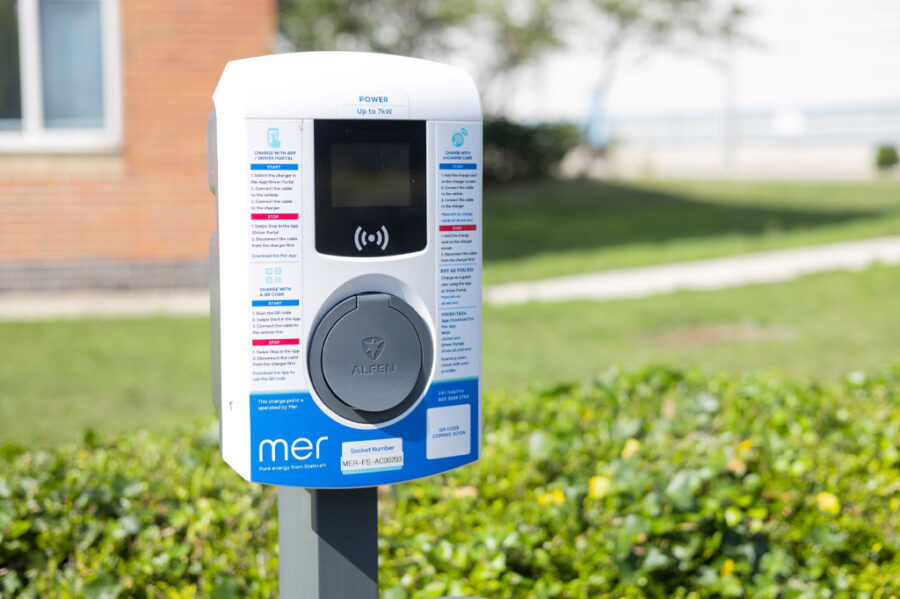
On top of this, the law states that charge points must be designed and manufactured to provide adequate protection against physical damage, including a tamper-protection boundary that protects the internal components of the charge point.
This includes:
If this all sounds complex, don’t worry! The legislation also ensures that a charge point must be configured “so as to minimise the inputs required from the owner in connection with the set-up and operation of the charge point.”
This means that they must be as easy to use as possible. However, the law is also designed to ensure that users can delete their personal data from charge points “without undue difficulty.”
According to the legislation, your charge point provider must supply the following information whenever you purchase a charge point:
While there are no stated plans to update the regulations, it’s likely that there will be a review in the not-too-distant future, given that they are now three years old and EV smart charging tech continues to evolve.
However, in May 2025, the UK Government made changes to Permitted Development Rules that meant home and business owners no longer had to get planning permission to install public or private EV chargers. It’s estimated that this could save some EV drivers up to £1,100 per year.
At Mer, we are fully aware of these charge point regulations and take care of all these elements for you. We can guide you through the compliance process when we install your fleet site EV chargers.
If you want to ensure that your new charge points are compliant with the latest legislation talk to us on 03300 562 562 or email our team at sales.uk@mer.eco.
The EV transition can feel confusing for UK fleet operators. Ince...

Be.EV, the public charging network built around drivers, has acqu...

In this article we examine the relationship between agriculture a...