
What we’ve learnt from supporting EV fleets through Round 1 of the Depot Charging Scheme
At Mer Fleet Services, we supported organisations including IKEA,...

*Updated in August 2024.
To charge a fleet electric vehicle or plug-in hybrid electric car, you will need to plug it into a EV charging point, usually at the depot, but occasionally at at a public charging station. How long it takes to charge your EV can vary. It can take anything from 20 minutes to 24+ hours depending on the power output of the charging point you use, and the capacity and charging speed of the EV’s battery.
You’d be easily forgiven for finding the world of electric charging complex. There’s a lot to get your head around. In fact, the RAC have specifically criticised the ‘lack of standardisation of connectors’ and ‘bewildering array of types of charge points, connectors and tariffs’… if only it was as easy as ‘pull up, plug in, drive off’.
However, businesses electrifying their entire vehicle fleet have an advantage. By deploying dedicated EV fleet charging infrastructure, organisations can choose the vehicles, chargers and charging strategy that best suit their operations.
In many ways, EV fleet charging is much more simple than navigating public charging infrastructure. Even so, we’ve broken down the essential facts about EV fleet charging, such as how long it will take, what it could cost, the types of EV connectors and where you can charge, to help you get to grips with the basics.
Charging an EV is a straightforward action. Using an EV connector, you plug your vehicle into an EV charge point, and power up. The efficiency of the charge and the amount of power you can obtain will depend on the ability of your fleet EV to accept high-powered charging, as well as the speed of the charge point your depot is using.
In most cases, vehicles are charged at operational depots using dedicated fleet charging infrastructure designed for business fleets.
So, what’s an EV connector? To charge, EVs have to be connected to a charge point via a cable. This cable has a ‘connector’ at either end, one to plug into the car inlet, and one to plug into the charger unit outlet.
These EV chargers for fleets are referred to as ‘untethered’ and they can often also be found on lamposts and other places for public use. While they’re small and inconspicuous, they require the driver to carry their charging cable with them. ‘Tethered’ EV chargers have one end permanently connected to the charger, and these are commonly found across public and private charging networks. Because EV fleet operators often use the same vehicle and charge in the same place, this can save weight and ensure the cable is always available,
EV connectors are perhaps the most confusing part of electric charging – because there is no universal connector type…
The connector type accepted by the vehicle inlet varies from model to model, and when it comes to the charging unit outlet, it varies depending on the power rating. When investing in EV fleet infrastructure, you’ll have the advantage of being able to choose both the vehicle and charger type, allowing you to maximise efficiency and streamline costs.
However, some fleet EVs will still need to charge away from their home base, and most EVs come with 2 extra cables that enable you to charge via different charge point connectors – the charge may just be less efficient. But be aware of your model’s limitations!
Vauxhall Corsa-e: these vehicles use the CCS charging standard, which consists of a combined AC and DC inlet port. For public slow and fast AC points, it can be charged with a Type 2 connector, and for rapid DC charging, a CCS connector.
Nissan LEAF: It accepts two connector types – Type 2 for slow and fast AC charging and CHAdeMO for rapid DC charging.
BMW i3: this model also has a combined AC and DC inlet port. Part of the inlet is for a Type 2 connector for slow and fast charging and the other is for a CSS connector, for rapid charging.
Tesla Model 3: The Model 3 uses a Type 2 inlet when charging at home or public slow and fast AC points, while a CCS inlet is used for rapid DC charging from a CCS connector.
Ford E-Transit: The Ford E-Transit van uses a Type 2 (AC) and a CCS (DC) connector to use a range of home, public or business/depot chargers.

How long it takes to charge an electric car can be as little as 20 minutes via a public rapid charger (charging within the suggested safe range of 20%-80%), or as much as 24+ hours for some models if you were to use a domestic plug at home.
Your personal charge time will depend entirely on the size of your EV battery and the speed of the charge point you use, as well as the capacity of the vehicle to accept the charge speed.
As a guide, a 7kW home EV charger should charge a 60kWh EV battery, like those found in Tesla Model 3s, in around 8 hours from empty to full. Using the same EV charger on the 40kWh battery found in a Nissan LEAF would take around 5.5-6 hours, while an 82 kWh battery found in a VW ID.5 would take 12.
Nissan LEAF: the LEAF has a 40kWh battery. Using a domestic socket, fully charging the battery will take 21 hours. If you were to get a 7kW home charging unit installed or use a fast public EV charger, it would take 7.5 hours to charge.
If you used a 50kW public rapid charger, you can charge from 20-80% in 60 minutes. With the Nissan LEAF, a full charge will take you up to 168 miles.
Vauxhall Corsa-e: the electric remake of the hugely popular model, uses a 50kWh battery. Using a domestic socket, charging the battery to 80% will take 19.5 hours, while a 7.4kW home charger could reach 80% charge in 6 hours. Finally, using a rapid 100kW charging station can get you to 80% charge in just 30 minutes. Charging to 80% will take you an estimated 168 miles.
Tesla Model S: with its 75kWh battery, a domestic socket would take 30-40 hours to charge fully. A 7kW home EV charger would achieve full charge in around 11 hours, and a 22kW charger would take 5-6 hours. Using a rapid 150kW charger would achieve full charge in just 30 minutes and give a range of around 240 miles.
The popular Kia EV6 has a similar battery size with roughly the same charging times.
MG4 EV: Using a 64kWh battery, a 7kW home EV charger would achieve full charge in around 8-9 hours, and a 22kW charger would take 5 hours. Using a rapid 150kW charger would achieve full charge in just 30-40 minutes and give a range of around 275 miles.
If you’re looking to electrify your fleet, or provide charging at business and operational sites, you will most definitely need to consider the costs of charging units. The cost of EV chargers will vary depending on the charge speed you want, ranging from hundreds to thousands. But government discounts are available to businesses, enabling you to get a £350 discount on each socket, for up to a total of 40 sockets (up until 31st March 2026). Many organisations begin by developing a clear EV fleet charging strategy before installing infrastructure across their sites.
To qualify for the grant, businesses need to use a supplier (such as Mer) approved by the Office for Zero Emission Vehicles (OZEV) – formerly OLEZ.
Installing EV chargers at your business location can bring a lot of advantages with it, enabling you to quickly see the return on your investment.
There are 3 main types of chargers used to power EVs in the UK, and they are most commonly referred to as ‘Slow’ ‘Fast’ and ‘Rapid/Ultra Rapid’. The clue is in the name as to what to expect – each one offers a different power output and therefore a different EV charging speed…
As mentioned earlier, each charger type has its specific connector requirements. It’s important to understand where your model of EV can be charged. For example, some EVs and plug-in hybrids cannot use rapid chargers.
Yes. Most EVs can use AC and DC chargers, so a fleet car can also be charged on a home of public charger. Your company may have agreements with public charge point operators to allow you to charge your fleet car away from the depot. This is especially useful if you need to recharge en-route during longer journeys.
On average you can expect to spend £1.50 per hour of charge when using a fast public charger, and £6 for a 30-minute charge with a rapid charger. The cost of public charging points varies, and some charge point hosts, such as shopping centres or supermarkets, offer free charging while you visit them.
Some charge points will charge based on the time spent charging, and some based on the electricity used. Rapid charge points are naturally more expensive, as you can cram in more power in a short amount of time. As a result, many charge based on time spent, with a surcharge on the amount of electricity used.
How to charge an EV at a public charging station can vary depending on the provider. In some cases, you’ll be able to just pull, plug in and tap your card to start the charge. The EV charger provider may take a set amount upfront, and then refund you/charge more when you finish the session.
Other public charge points may offer better rates for members, in which case you may need to log in with an app or tap a membership card to start the charging process.
Car Magazine offers a handy way to calculate a rough estimate of what you can expect to spend when charging at home or in public: Size of battery (kWh) x Electricity cost of your supplier (pence per kilowatt hour) = Cost to charge an electric car from empty to full.
The average domestic electricity rate is about 26p per kWh. And the average cost of using rapid chargers is 40p per kWh.
| How long does it take to charge? | 6-12 hrs for a pure EV, Or just 2-4 hrs for a hybrid |
| Suitable for commercial or personal use? | Personal |
| How many miles of range per hour of charging? | Up to 15 miles per hour of charge |
| How many Kilowatts of power can it give you? | Up to 3.6 kW |
| What’s the installation process? | The charging unit can be plugged into a standard outlet, no extra equipment necessary. |
| AC or DC Charging? | AC |
| What connectors are required? | 3-pin 3kW AC, Type 1 3kW AC, Type 2 3kW AC, Commando 3kW AC |
As the name suggests, you’ll get an accelerated power-up with a fast-charger – but expect a higher initial financial outlay if you want this type of charge unit at home. You can also find these types of charge points at both public and commercial charging stations. Note that 22kW chargers will require 3-phase power.
What you need to know:
| How long does it take to charge? | 3-5 hrs |
| Suitable for commercial or personal use? | Both |
| How many miles of range per hour of charging? | 10-90 miles per hour of charge |
| How many Kilowatts of power can it give you? | 7kW to 11kW (occasionally up to 22kW) |
| What’s the installation process? | Professional installation required. |
| AC or DC Charging? | AC |
| What connectors are required? | Type 2 7-22kW AC, Type 1 7kW AC, Commando 7-22kW AC |
Rapid and Ultra Rapid chargers are typically found at service stations or fleet EV charging hubs, due to the level of installation and maintenance required although they are starting to appear in cities too. They offer the fastest charge – but this comes at a higher cost.
What you need to know:
| How long does it take to charge? | Get an 80% charge in 20-40 minutes (most rapid charging units will stop at 80% to protect the battery life) |
| Suitable for commercial or personal use? | Commercial |
| How many miles of range per hour of charging? | 60-100 miles |
| How many Kilowatts of power can it give you? | Rapid AC chargers can give you 43kW, Rapid DC chargers can give you 50kW, Ultra Rapid DC chargers can give you up to 350kW |
| What’s the installation process? | Professional installation required. |
| AC or DC Charging? | Both options possible. |
| What connectors are required? | CHAdeMo from 50kW DC, CCS from 50kW DC, Type 2 43kW AC, Tesla Type 2 120kW DC |
Alongside their fleet charging requirements, many businesses have started to install EV charge points for their employees – as part of CSR initiatives, to attract new employees and service their growing EV fleets. So you may already be able to leave your car on charge while at the office (once you’re back in of course!).
If you’re a business weighing up the pros & cons of installing fleet chargers, take a look at our recent blog on business site EV charging.
Hopefully this guide has broken down the key facts around EV fleet charging, so you know what to expect before you decide to buy or lease your first EV, convert your fleet, or maybe provide charging stations for your employees.
Get in touch to find out how we can help you get set-up for EV charging!
At Mer Fleet Services, we supported organisations including IKEA,...
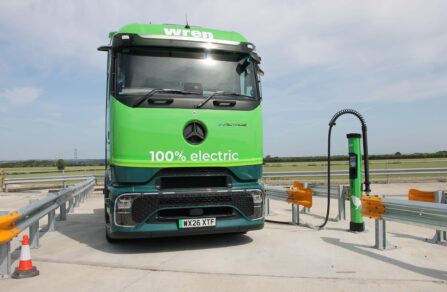
When Wren Kitchens introduced its first electric HGVs, the chargi...
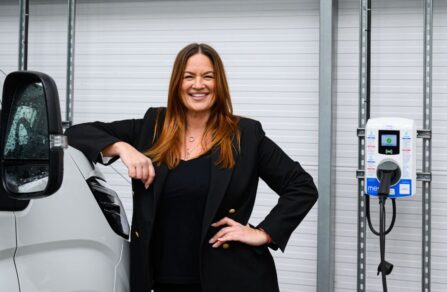
Natasha Fry, Chief Commercial Officer at Mer Fleet Services, has ...