What are EV Charging Hubs? Where and How to Install Infrastructure
Will the future of electric vehicle charging in the UK see EV cha...
| Country | Language |
|---|---|
 Deutschland
 |
de / en |
 Norge
Norge |
no / en |
 Sverige
 |
sv / en |
 United Kingdom
 |
en |
 Österreich
 |
de |
 mer.eco
|
| Country | Language |
|---|---|
|
Deutschland |
de / en |
|
Norge |
no / en |
|
Sverige |
sv / en |
|
United Kingdom |
en |
|
Österreich |
de |
|
mer.eco
|

There are three key methods that EV drivers use to charge their cars: at home, at work, and on the public network. Of these, home charging is the most popular because of the cheaper rates and accessibility. However, installing a charger at your own home can be expensive, and it requires either a driveway or garage.
The data reflects this:
In a perfect world, owning an electric vehicle and a place to charge it would be ideal. However, we know that lifestyles are changing and housing stock is increasingly challenged.
These factors contribute to more households being unable to install a home EV charging socket at their property. Our driver responses reinforce what we already know; the need for a public charging network that is fit to support electric mobility is critical.
While there are numerous Government initiatives for on-street charging, our survey findings suggest the private sector holds some of the best locations for EV charging hubs.
It’s not surprising that when we asked our drivers where they think it is most convenient to charge their EVs, we saw a fairly even split:
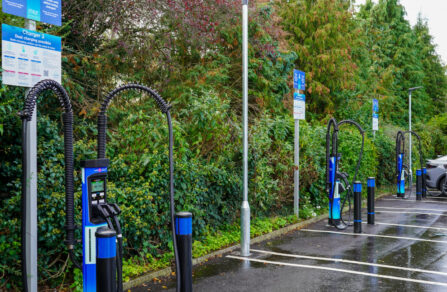
People are busy, and EV charging hubs installed in the car parks of retail and garden centres can make their lives easier. These sites have space for a greater quantity of chargers, as well as more powerful and modern charging equipment. With added benefits of on-site security such as cameras and fencing, drivers can be assured their EVs are safe while they do their shopping, grab a bite to eat, or go for a walk.
Situating EV charging infrastructure at private retail parks and other similar destinations also makes sense from a user behaviour perspective. When we asked our drivers about what activities they engage in as their vehicle charges, the results were unsurprising:
For retail site and destination owners, the installation of EV charging stations in their car parks helps bring in new customers. EV charging is a potent attractor for these locations, with 41% of people surveyed stating that they visited a retail site or garden centre because of the presence of EV charging. Coupled with most of them looking to either eat or shop, these electric vehicle owners become a powerful source of incidental expenditure.
In previous surveys, EV drivers ranked being close to a main road as a bigger priority than the site having shops and restaurants. In 2025, this changed; drivers place a greater emphasis on having plenty of amenities versus being placed near a road alone.
A focus in the early days of EV adoption was making sure that the major routes of the UK all have easily accessible EV charging, and this has proven to be a success. But now, we have reached the point where the targeting for the UK’s EV charging infrastructure needs to expand. As more electric vehicles hit our roads, their drivers want to be entertained while their car gets the boost that it needs.
Overall, the data from our surveys suggest that EV charging hubs located in the car parks of retail sites and other destinations will become some of the most popular locations for drivers to charge their vehicles.
For owners of retail sites which can support EV charging infrastructure, the presence of chargers can help to increase your revenues, land value, and attractiveness to tenants, as well as boost your sustainability goals.
If you want to find out more about whether an EV charging hub is a good fit for your site, download our EV charging hubs guide.
Will the future of electric vehicle charging in the UK see EV cha...

Elizabeth Warren, Director of Public Charging at Mer UK, notes th...

Mer has installed a series of ultra rapid EV chargers at the hist...
Sources:
1. https://www.transportxtra.com/publications/parking-review/news/66621/a-third-of-uk-homeowners-don-t-have-a-driveway-or-garage-to-install-a-home-chargepoint/
2. https://www.ons.gov.uk/peoplepopulationandcommunity/housing/bulletins/housingenglandandwales/census2021
3. https://www.fjpinvestment.co.uk/the-great-uk-home-shrink-why-are-houses-getting-smaller/
4. https://www.ons.gov.uk/peoplepopulationandcommunity/housing/bulletins/housingenglandandwales/census2021
