
Keltruck Future-Proofs Business with a New Electric Vehicle Fleet
Keltruck Ltd is Europe’s largest independent Scania distributor. ...
| Country | Language |
|---|---|
 Deutschland
 |
de / en |
 Norge
Norge |
no / en |
 Sverige
 |
sv / en |
 United Kingdom
 |
en |
 Österreich
 |
de |
 mer.eco
|
| Country | Language |
|---|---|
|
Deutschland |
de / en |
|
Norge |
no / en |
|
Sverige |
sv / en |
|
United Kingdom |
en |
|
Österreich |
de |
|
mer.eco
|

This post was updated on 28/01/2026
Many UK motorists are aware of the need to move away from ICE vehicles and do their bit for the environment. They also feel the ever-increasing costs of motoring in their wallets. As they make lifestyle changes, they look to their employers and the companies they do business with to do the same.
For businesses, this represents a vital part of your plans for 2026 and beyond.
As of December 2025, there are an estimated 1.8 million fully-electric vehicles (EVs), and 980,000 plug-in hybrid (PHEV) models recorded on UK roads (1). This means there are around 2.8 million private vehicles that require charging in some form. In 2025, these accounted for 34.5% of all new cars sold.
The electric revolution is not just coming, it’s here.
With increasing numbers of EV drivers, better charge point infrastructure and EV charging strategies are required, and with that comes an opportunity for businesses.
Clear benefits to installing EV charging infrastructure that most businesses can’t and shouldn’t ignore are:
In this article, we’re going to discuss a range of EV charging strategies for businesses and some of the benefits that EV charging stations can bring for those who invest in the future.
If a potential customer can get something they need and charge their car at the same time, it’s more likely they will choose your organisation. Even with ultra-rapid chargers, EV drivers may still need to stop for 45 – 60 minutes to top up their cars. Regardless of your business type, installing an EV charger can help you improve footfall with this audience.
EV drivers rely on apps such as Zap-Map to locate charge points, and if you wish, your business can be referenced publicly.
With time on their hands, EV drivers dropping by to charge are likely to explore your business offering. Whether it’s stopping for a coffee, doing some shopping, or even going for a workout, it’s another way to attract customers.
Likewise, you can add your EV charging facilities to your business listings on places like Google, Bing or Apple maps, and any local business directories.
One of the main inconveniences of EVs remains their charging time. For convenience, many EV drivers will likely want to have the option to charge while they shop. Therefore, offering fast, reliable and affordable charge points can sway a customer’s decision.
With many businesses struggling to compete with online stores and operating in a difficult economic environment, it’s becoming more and more important to provide a superior and convenient shopping experience.
Smart EV charging can allow drivers to connect with a business if they stop to charge, meaning allowing you to gain customer insights and even communicate deals and offers, increasing the likelihood of return visits.
Adding EV charging facilities for both staff and customers can form a vital part of your customer retention strategy in 2026.
Encouraging your customers and staff to adopt cleaner methods of transport can help you reduce your organisation’s carbon footprint and support green business practices.
Transport accounted for 29% of UK CO2 emissions in 2023 (2), with cars representing a sizable proportion of this. If the UK is to reach its net-zero target by 2050, a large cross-industry effort is required to encourage widespread EV adoption.
Many consumers and employees are acutely aware of greenwashing and are looking to organisations that follow through with their promises. One of the main EV charging benefits for businesses is that it’s a practical, visual example of your organisation’s values and commitment to sustainability.
If your brand or CSR policies are focused on sustainability and green business initiatives, the absence of EV infrastructure and prioritisation may undermine your efforts and erode trust.
One of the biggest benefits of EV charging stations for businesses is that it’s simply the right thing to do to enable our transition away from fossil fuels. Modern consumers know how to spot when a brand isn’t being genuine, so it’s important to back up words with actions.
Many of your employees may drive EVs, and offering EV charging on-site can be an excellent perk to attract and retain your staff. Alongside this, it can demonstrate proactive investment in culture and innovation.
Having an EV infrastructure in place demonstrates a proactive approach to innovation and modern culture – and may tip the balance in attracting top employees as well as retaining your workforce. And if you’re able to electrify your fleet, the government has now introduced tax cuts for employees using corporate EVs for personal use (3) – a great perk for new and existing employees.
As EV charging strategies for businesses go, the ability to apply for government support such as the Workplace Charging Scheme (4) and the EV Infrastructure Grant for Staff and Fleets (5), as well as the potential to manage and offset your tax obligations, can make excellent financial as well as reputational sense.
Adding EV charging infrastructure to your business can provide an additional revenue stream and turn parking spaces into profit. Whether you choose to own the infrastructure yourself, choose a Charging-as-a-Service approach, or a blend of the two, you can open up additional avenues for profit.
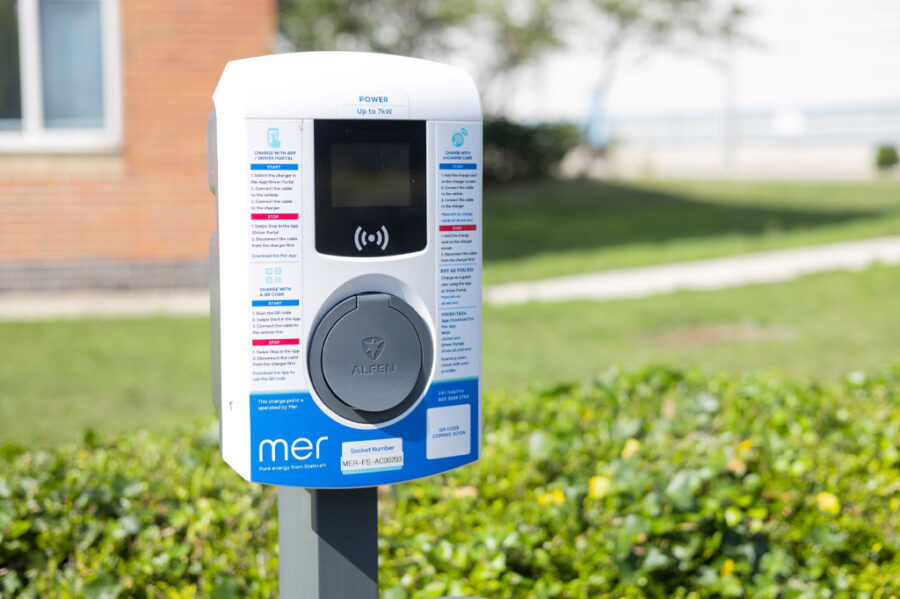
Many businesses and organisations already offer EV charging, and it’s important not to get left behind.
With the introduction and expansion of ULEZ in London, other cities implementing their own low and zero-emission zones, and a ban on new diesel and petrol cars and vans to be implemented by 2030 (6), the pressure on businesses to upgrade their fleet is increasing.
With the EV market growing, widespread adoption and the expectation for charging provisions in workplaces as standard are here. Businesses that invest now can take advantage of existing workplace grant schemes for installing charge points or buying certain new EVs for their fleet (7).
Likewise, those that operate large fleets of electric cars or vans will be able to save money in the long term by installing their own EV fleet charging infrastructure. This is a significant investment, so it pays to start early and get ahead of the 2030 deadline.
For those really looking into the future, an investment in renewable energy generation, such as wind or solar, could further increase savings and reduce carbon emissions.

You first must understand how many charge points you need to adequately serve new EVs in your fleet, employees, visitors, and/or customers. Mer can help you establish and forecast what your requirements may be, both now and in the future.
With this info, you can set goals for how many charge points you want to invest in, how many EVs you’d like to run, the percentage reduction on your emissions, or how many employees you’d like to use EVs.
There are many things to consider when it comes to mapping the costs and working out the ROI, such as:
Read our blog EV Charging for Business – What Are The Costs & ROI for more insights on the costs involved.
Once you’re ready to find out more about EV charging for your sector, you should contact a reputable commercial charge point operator to request a site visit before taking any further action.
The operator will be able to:
In order to provide such detail, an operator will need to assess the premises, the location of the meter, the maximum electrical capacity, and the space capacity (the difference between actual load used and the maximum available).
The number and type of EVs using your charging infrastructure will impact the number and type of charge points needed.
It’s important to bear in mind that some older EVs can only use slow chargers, but the majority on UK roads now can use fast, rapid and ultra-rapid. While rapid chargers will reduce charge time, they’ll also increase the electrical load.
Remember that the number of vehicles being charged is closely linked to downtime. Therefore, your specific business needs may mean you regularly have a large number of EVs charging for a long time all at once, meaning you will need more charge points, but they won’t necessarily need to be rapid chargers.
If your charge points will be used by employees, guests, and customers, you may not know the EV model types. Instead, you may need to focus on estimating usage based on what you do know or can find out. For example:
The operator visiting you will be able to advise on the best type of charger(s) to accommodate most vehicle models.
Investing in EV charging infrastructure for your business can bring a range of benefits. From employee satisfaction to customer retention, enhanced green credentials to additional revenue streams, it’s something all businesses should consider.
At Mer, we’ve got years of experience in helping businesses, local authorities, and public sector organisations electrify their fleet and invest in their premises. To find out more, contact us to talk to one of our EV charging hub experts.
Alternatively, download our EV Charging Hubs Guide.
Keltruck Ltd is Europe’s largest independent Scania distributor. ...
Costain required a partner to design and deliver EV charging infr...

County Durham and Darlington NHS Foundation Trust wanted to insta...
Sources